The Kylo GLOW Stack is a research blend of three peptides, GHK-Cu, BPC-157, and TB-500, studied for their roles in tissue repair, skin remodeling, and cell signaling. Think of it like a garden bed planted with companions: one plant enriches the soil, one fends off pests, one helps roots spread. Each peptide does a different job, and researchers are curious about what happens when they work together.
That’s the appeal of a product like this one. Instead of looking at one compound at a time, it bundles three of them so scientists can study how they interact.
Here’s the honest part. Most of the evidence comes from lab and animal studies, not large human trials. These compounds are sold for research use only, and the science is still early, like a seedling that hasn’t proven itself through a full season yet.
In this guide, we’ll break down what each peptide is, what research says it does, and how the stack is used in studies, all in plain language, no lab coat required.
What the GLOW Stack Means in Plain Language

Think of a peptide as a very short chain of amino acids, the same building blocks that make up proteins, just far fewer of them linked together. Many peptides act like tiny messengers, telling cells when to repair, move, or make something new. A “stack” simply means several compounds studied side by side instead of one at a time.
Why combine them? Gardeners already know the logic. In the old “three sisters” planting, corn gives beans something to climb, beans feed nitrogen back into the soil, and squash leaves shade the ground to hold in moisture. No single plant does all of that, but together the bed works better than any one crop alone. Researchers think along similar lines: if each peptide touches a different part of tissue repair and renewal, studying them together may reveal something a single compound can’t.
It also helps to know that “GLOW” is a marketing-style nickname, not a formal scientific category. You won’t find it as an official classification in a pharmacology textbook. Formulations can differ between suppliers, too, so one lab’s “GLOW” blend may not match another’s in what it includes or how much.
Here’s a quick glossary to keep handy:
- Peptide
- A short chain of amino acids that can act as a signal telling cells to do a particular job.
- Stack
- A combination of several compounds studied together rather than individually.
- Research-use-only
- A label meaning a compound is sold for laboratory study, not as an approved treatment or consumer product.
- In vitro vs. in vivo
- In vitro studies happen in cells in a dish, while in vivo studies happen in living organisms such as animals.
- Copper peptide
- A peptide that binds copper, such as GHK-Cu, which is studied for its role in skin and tissue pathways.
Keep these terms in mind, because they’ll come up again as we look at each component.
How the Peptides in the GLOW Stack Work Together
Researchers don’t treat the GLOW Stack as one single “magic” ingredient. They look at it as a team where each peptide is studied for a different job in the repair-and-renewal process.
Think about how a tomato plant actually thrives. Soil gives it a stable foundation and nutrients, water keeps everything moving, and sunlight powers the growing. None of them can do the others’ work, and a plant missing any one of them struggles. If you’ve ever read up on soil health principles you know that a good garden comes from several things working in balance rather than one big fix.
Researchers think about the stack in a similar spirit. GHK-Cu is explored for skin structure and collagen-related pathways. BPC-157 is studied for how tissues like tendon, muscle and gut lining repair themselves. TB-500 is looked at for cell movement and blood vessel formation, which matter when the body is rebuilding. The idea is that each one might touch a different part of the same overall process.
That said, it’s important to stay honest about where the science stands. Most of what we know comes from cell cultures and animal studies, and data on the three peptides used together in people is thin. There is only limited evidence that the combination does anything more than its parts, so any talk of teamwork is a hypothesis, not a proven result.
The Peptides Behind the Stack: What Each One Contributes in Research
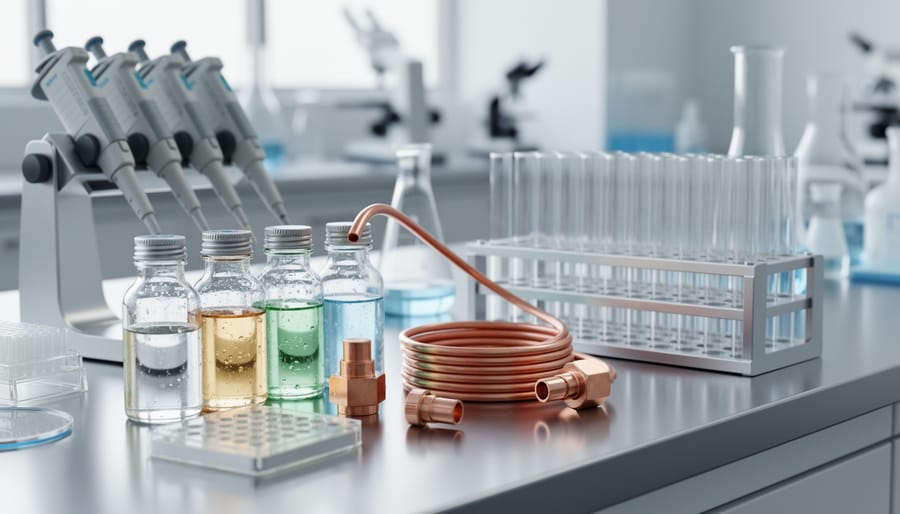
GHK-Cu: The Copper Peptide Studied for Skin and Collagen
GHK-Cu is a small peptide made of three amino acids that naturally binds copper. It was first identified in human blood plasma, and it shows up in other tissues too. Think of it like a little courier carrying a trace mineral, much as a gardener carries a pinch of iron to a struggling plant.
Researchers have taken an interest in GHK-Cu for a few reasons. In lab studies, it has been explored for its role in skin remodeling, collagen production and wound-healing pathways. Cells in a dish, and some animal models, have shown responses that make scientists curious about how it nudges the body’s repair signals.
Another reason it draws attention is that natural levels appear to fall as we age. Plasma concentrations are often reported to be higher in younger people and lower later in life. That pattern leads researchers to ask whether this decline connects to slower tissue renewal, though that question is still open.
Here is a quick way to see how each peptide in the stack fits in, based on its main research focus:
- GHK-Cu: skin and collagen-related pathways.
- BPC-157: tissue repair and gut-related studies.
- TB-500: cell migration and tissue recovery.
It’s worth keeping perspective. Much of what we know about GHK-Cu comes from lab work, and results in a petri dish don’t always carry over to people. Like a seedling that thrives indoors but struggles outside, early promise needs careful testing before anyone draws firm conclusions.
BPC-157: The Repair-Focused Peptide
BPC-157 is a short peptide made of 15 amino acids. Its name stands for “body protection compound,” and it’s a fragment of a larger protein first identified in human gastric juice, the fluid in your stomach. Think of it like a cutting taken from a bigger plant: it carries just one small piece of the original, but that piece is what researchers wanted to study.
Most of what we know comes from animal work, mainly in rats. In those studies, scientists looked at how BPC-157 affected the healing of injured tendons, damaged muscle, and irritated gut lining. Reported results included faster tissue recovery in several of these models, and some researchers have suggested it may influence blood vessel growth and the way cells respond to injury. It’s an interesting pattern, and it explains why the peptide earned its “repair-focused” reputation.
Here’s the honest part, though. Human clinical data is sparse. A handful of small or preliminary reports exist, but there are no large, well-controlled trials that show it works or is safe in people. Results that look promising in a lab animal don’t always carry over to humans, the same way a tomato variety that thrives in one greenhouse can struggle in your backyard. For now, BPC-157 is best understood as a compound that’s still being investigated.
TB-500: The Recovery and Cell Movement Peptide
TB-500 is the third member of the stack, and its job in research is all about movement. It’s a synthetic fragment related to thymosin beta-4, a protein found naturally in many human tissues. Scientists often compare the two, but TB-500 is a lab-made piece rather than the full-length protein, so findings about one don’t automatically apply to the other.
Think of it like the way a gardener moves compost and water to where roots need them. In lab settings, researchers have studied how thymosin beta-4 and its fragments influence cell migration, meaning how cells travel toward an area that needs repair. They’ve also looked at angiogenesis, the formation of new blood vessels, which matters because healing tissue needs a good supply line, much like a seedling needs a steady water source.
Other research has explored tissue recovery in cell cultures and animal models, including interest in how it may affect inflammation and the repair of muscle and connective tissue.
Here’s the honest part: human evidence is limited. Most of what we know comes from lab and animal studies, and there’s little high-quality clinical data confirming that these effects carry over to people. TB-500 is also sold as a research compound, not an approved treatment. So it’s best viewed as an interesting area of study, not a proven solution.
How Researchers Use and Study the GLOW Stack
When people talk about the GLOW Stack, the conversation usually starts in a lab, not a garden bed. Much of what we know comes from cell cultures, where researchers watch how skin cells or other tissue cells respond to a single compound. Next come animal studies, which look at things like wound closure, tendon repair, or gut lining recovery. A smaller group of early-stage investigations looks at skin quality and general recovery, but these are limited in size and scope.
This is also why the phrase “research use only” matters. It signals that these compounds are sold for laboratory work, not as approved products for people. Careful labeling keeps everyone honest about where the science actually stands.
Study design shapes what we can conclude, too. A small animal study with no control group tells us far less than a well-run trial with a comparison group. Think of it like gardening: if you change the soil, the watering, and the sunlight all at once, you can’t tell which change helped your tomatoes. Good researchers change one thing at a time. That’s the same mindset behind the evidence-based tips we share for keeping a garden healthy.
Finally, lab results don’t automatically carry over to people. A seedling thriving in a greenhouse may struggle outdoors, and cells in a dish or a mouse can behave very differently from a human body. Curiosity is great, but patience and good evidence come first.
Common Questions About the GLOW Stack
Here are quick, honest answers to the questions people ask most often.
Is the GLOW Stack a single product or a mix?
It’s a mix. “GLOW” is a marketing-style label for a combination of separate peptides, commonly described as GHK-Cu, BPC-157 and TB-500, so exact formulations can differ between suppliers.
Why are these particular peptides combined?
Researchers are interested in each one for a different part of tissue repair and skin renewal, a bit like beans, corn and squash each doing their own job in a garden bed. Whether the combination works better than each peptide alone hasn’t been well tested.
Is the research on humans or animals?
Mostly cell cultures and animal studies, especially for BPC-157 and TB-500. Human data is limited, and these remain research compounds, not approved treatments.
Where can I learn how to read peptide research responsibly?
Start by checking whether a study used cells, animals or people, how large it was, and whether other labs repeated it. Learning to spot weak claims is a lot like learning what actually works instead of trusting hype.
Just like in the garden, a little patience and a healthy dose of curiosity go a long way when you’re sorting solid information from wishful thinking.
So, here’s the short version. GHK-Cu is the copper peptide researchers look at for skin and collagen pathways. BPC-157 is the repair-focused one, studied mostly in animal models for tendon, muscle and gut tissue. TB-500 is the recovery peptide, explored for cell movement and blood vessel formation in lab settings. Three different jobs, one shared stack.
Keep in mind that the evidence is still growing, and most of it comes from cells and animals, so this article is for educational context only. Good gardeners know that patience pays off. You learn one layer at a time, test one change, and watch what actually happens. Keep exploring reliable, evidence-based sources, and stay curious.